
If you’ve felt more wired, more scattered, or more «on» than usual lately, you’re not imagining it. Somewhere between endless notifications and doom-scrolling, a lot of us lost the ability to just… sit with one thing. And it turns out one of the simplest ways back to calm isn’t a $200 app or a silent retreat. It’s a pencil, a grid of letters, and twenty minutes of quiet.
What «regulating your nervous system» actually means
You’ve probably seen the phrase everywhere lately — regulate your nervous system, come back to your body, get out of fight-or-flight. Stripped of the buzzwords, it simply means helping your body shift out of high alert (scattered thoughts, shallow breathing, that low hum of anxiety) and into a state where you feel steady and present.
Your nervous system doesn’t calm down because you decide to relax. It calms down through repetition, predictability, and single-tasking — the opposite of what a phone screen gives you.
Why puzzles work so well for this
A word search is, structurally, almost the perfect calming activity:
- One task, one focus. Your eyes scan a grid, your brain looks for a pattern, that’s it. No tabs, no pings, no decisions.
- Predictable and achievable. You know the word is in there. There’s no ambiguity, no open loop — just find it. That certainty is soothing in a way open-ended tasks aren’t.
- Repetitive motion. Scanning row by row, letter by letter, has the same steady, rhythmic quality as knitting or coloring — activities therapists have long pointed to as naturally grounding.
- A built-in stopping point. Unlike a screen, a puzzle book has an edge. You finish a page and you’re done. Nothing is pulling you to «just one more.»
None of this requires you to meditate, journal, or do anything that feels like a chore. You just… pick up a pencil.
Why word search specifically (and not, say, sudoku)
Word search uses a gentler kind of focus than number puzzles. There’s less pressure, no wrong answers, no math anxiety creeping in — just gentle visual scanning. It’s the puzzle equivalent of a slow walk rather than a workout. That’s exactly why it works so well as a wind-down activity, not a brain-training one.
Building a tiny analog ritual around it
You don’t need a whole routine. Just borrow the shape of one:
- Put your phone in another room (or at least face-down, on silent).
- Make tea or coffee — something with its own little ritual.
- Open to one puzzle. Just one.
- Let yourself stop when it’s done, even if you want to keep going.
That’s it. Fifteen minutes, most days, is enough to notice the difference.
Why the look of your puzzle book matters more than you’d think
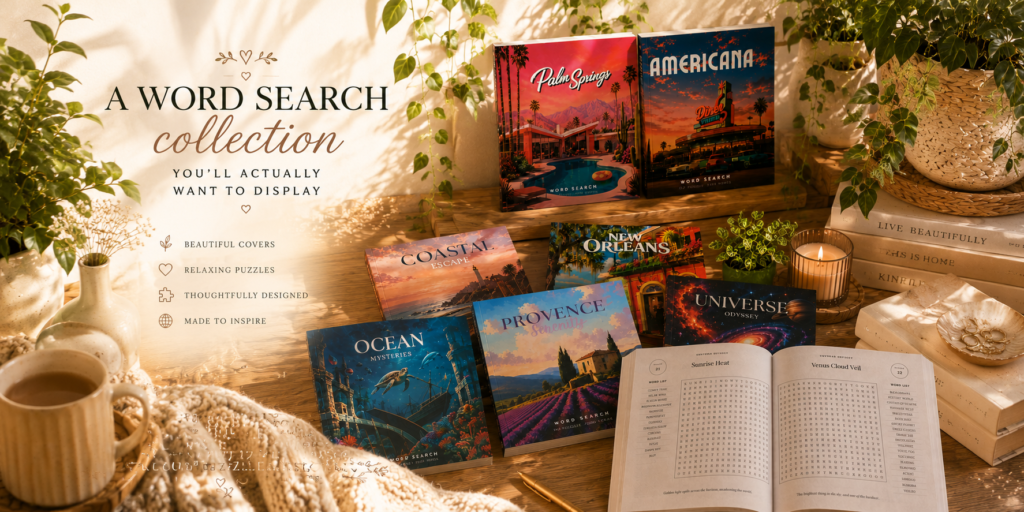
Here’s the part most people don’t talk about: if a puzzle book looks like something from a hospital waiting room, you’re not going to reach for it. But if it looks like something you’d want sitting on your coffee table — a soft, painterly cover, a palette you actually love — you’ll pick it up the way you’d pick up a good book or a candle. That’s the whole idea behind the CloverPuzzleBliss collection: a large, square 8.5×8.5″ format with cover art designed to feel like a small piece of art, not a workbook. Titles like Palm Springs, Americana, and Universe are built to be beautiful enough to leave out, not hide in a drawer.
If you’ve been looking for a screen-free way to come down at the end of the day, this might be the smallest, easiest place to start.